
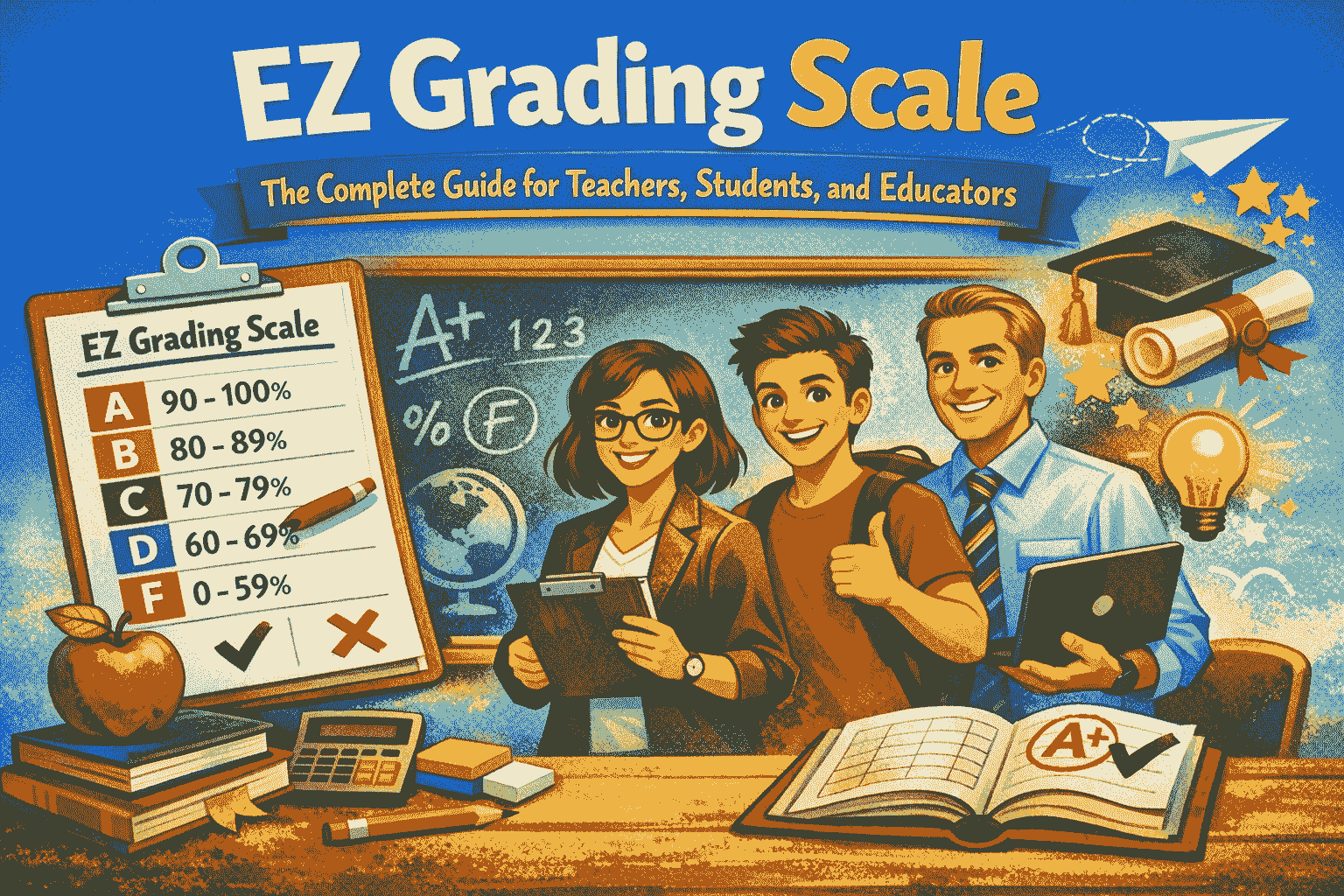
If you’ve ever struggled to convert raw scores into fair and consistent grades, the EZ grading scale is one of the simplest and most effective systems you can use. Designed to make grading faster, clearer, and more standardized, the EZ grading scale is widely used in classrooms, tutoring environments, and online learning systems.
In this SEO-optimized guide, you’ll learn what the ez grading scale is, how it works, how it compares to other grading systems, real-world examples, conversion tables, advantages, limitations, and practical applications for teachers and students.
What Is an EZ Grading Scale?
The EZ grading scale is a simplified grading system that converts raw scores (correct answers) into percentage-based or letter-based grades using an easy-to-understand structure.
Instead of manually calculating percentages every time, the EZ grading scale provides a standard conversion system that instantly translates performance into grades.
Simple Definition:
The EZ grading scale is a standardized method used to convert test scores into percentages or letter grades quickly and accurately without complex calculations.
Why the EZ Grading Scale Is Important in Education
Modern education demands efficiency and accuracy. Teachers often manage large classrooms, multiple assignments, and frequent assessments. The EZ grading scale helps solve these challenges.
Key Benefits:
1. Saves Time
Instead of calculating each score manually, teachers can quickly assign grades.
2. Ensures Consistency
Every student is graded using the same standardized conversion system.
3. Reduces Errors
Manual math errors are eliminated.
4. Easy for Beginners
Even new teachers or tutors can use it without training.
5. Works Across Subjects
From math and science to language arts, it works universally.
How the EZ Grading Scale Works
At its core, the EZ grading scale is based on a simple formula:Percentage=(Total QuestionsCorrect Answers)×100
However, instead of calculating this repeatedly, the scale provides pre-defined values.
Example:
- Test: 20 questions
- Correct answers: 16
- EZ grading scale result: 80% (B grade in many systems)
Standard EZ Grading Scale Chart
Below is a commonly used EZ grading scale for converting percentages into letter grades:
| Percentage Range | Letter Grade | Performance Level |
|---|---|---|
| 90–100% | A | Excellent |
| 80–89% | B | Good |
| 70–79% | C | Average |
| 60–69% | D | Below Average |
| Below 60% | F | Failing |
EZ Grading Scale for Different Test Sizes
10-Question Test
| Correct Answers | Percentage |
|---|---|
| 10 | 100% |
| 9 | 90% |
| 8 | 80% |
| 7 | 70% |
| 6 | 60% |
| 5 | 50% |
| 4 | 40% |
| 3 | 30% |
| 2 | 20% |
| 1 | 10% |
20-Question Test
| Correct Answers | Percentage |
|---|---|
| 20 | 100% |
| 19 | 95% |
| 18 | 90% |
| 17 | 85% |
| 16 | 80% |
| 15 | 75% |
| 14 | 70% |
| 13 | 65% |
| 12 | 60% |
| 10 | 50% |
50-Question Test (Simplified View)
| Correct Answers | Percentage |
|---|---|
| 50 | 100% |
| 45 | 90% |
| 40 | 80% |
| 35 | 70% |
| 30 | 60% |
| 25 | 50% |
EZ Grading Scale vs Traditional Grading Systems
Traditional Grading System
- Requires manual calculation
- Slower grading process
- Higher chance of error
- More complex for large datasets
EZ Grading Scale
- Instant conversion
- Standardized system
- Easy to use for large classes
- No calculator needed
👉 The EZ grading scale is essentially a simplified version of traditional grading systems designed for speed and efficiency.
How Teachers Use the EZ Grading Scale in Real Classrooms
1. Quiz Grading
Teachers use it to quickly mark multiple-choice quizzes.
2. Homework Evaluation
It helps in grading large batches of homework efficiently.
3. Exam Scoring
Midterms and finals can be graded faster using standardized tables.
4. Progress Tracking
Teachers use it to track student improvement over time.
Digital vs Paper-Based EZ Grading Scale
Paper-Based Version
- Printed charts
- No technology required
- Ideal for offline classrooms
- Can be laminated for reuse
Digital Version
- Spreadsheet-based
- Automated grading tools
- Online learning platforms
- Easy to customize
Advantages of Using an EZ Grading Scale
1. Time Efficiency
Grading becomes significantly faster.
2. Accuracy
Eliminates calculation mistakes.
3. Transparency
Students understand how grades are assigned.
4. Scalability
Works for both small and large classrooms.
5. Flexibility
Can be adapted to different grading systems.
Limitations of EZ Grading Scale
While highly effective, it has some limitations:
- Not ideal for weighted grading systems for which other grading tools can be used
- Limited flexibility for partial credit
- Not suitable for subjective assessments (essays, projects)
- Requires separate rubrics for complex evaluations
EZ Grading Scale vs Easy Grader Chart
| Feature | EZ Grading Scale | Easy Grader Chart |
|---|---|---|
| Purpose | Full grading system | Score conversion tool |
| Output | Letter + percentage | Percentage only |
| Usage | Broader academic grading | Quick lookup scoring |
| Flexibility | Higher | Lower |
Practical Applications of EZ Grading Scale
The EZ grading scale is widely used in:
- Schools (K-12 education)
- Universities (intro-level courses)
- Tutoring centers
- Online courses
- Certification programs
- Practice exams (SAT, ACT prep)
Tips for Using EZ Grading Scale Effectively
1. Combine With Rubrics
Use rubrics for essays and EZ grading for objective questions.
2. Keep Standard Charts Handy
Have printed versions for different test sizes.
3. Use Consistent Grade Boundaries
Avoid changing grading thresholds frequently.
4. Double Check Borderline Scores
Ensure fairness in A-/B+ range cases.
5. Digitize for Efficiency
Use spreadsheets for faster grading workflows.
Common Mistakes to Avoid
- Using wrong test size chart
- Misreading percentage ranges
- Ignoring rounding rules
- Mixing grading systems in one test
Future of EZ Grading Systems
With increasing adoption of AI in education, EZ grading scales are evolving into:
- Automated grading tools
- AI-powered evaluation systems
- Integrated LMS grading dashboards
- Real-time performance tracking systems
However, the core principle remains the same: fast, simple, and consistent grading.
FAQ: EZ Grading Scale
What is an EZ grading scale?
An EZ grading scale is a simplified system used to convert raw test scores into percentages or letter grades quickly and accurately.
How does the EZ grading scale work?
It uses a standardized conversion method based on the ratio of correct answers to total questions, multiplied by 100.
Is the EZ grading scale accurate?
Yes, it is highly accurate because it follows standard mathematical percentage formulas.
Can the EZ grading scale be used for all subjects?
Yes, it works across all academic subjects including math, science, and language arts.
What is the difference between EZ grading scale and grading chart?
The EZ grading scale is a complete grading system, while a grading chart is just a tool for quick score lookup.
Is EZ grading scale used in schools?
Yes, many schools and teachers use simplified grading scales for efficiency.
Can I create my own EZ grading scale?
Yes, you can easily create one using Excel or Google Sheets.
Conclusion: Why EZ Grading Scale Matters
The EZ grading scale is one of the most practical tools in modern education. It simplifies grading, saves time, improves accuracy, and ensures fairness across classrooms.
Whether you are a teacher managing dozens of students or a tutor grading practice tests, this system helps streamline your workflow while maintaining academic consistency.
As education continues to evolve toward digital and AI-driven systems, the EZ grading scale remains a foundational tool for fast and effective assessment.