
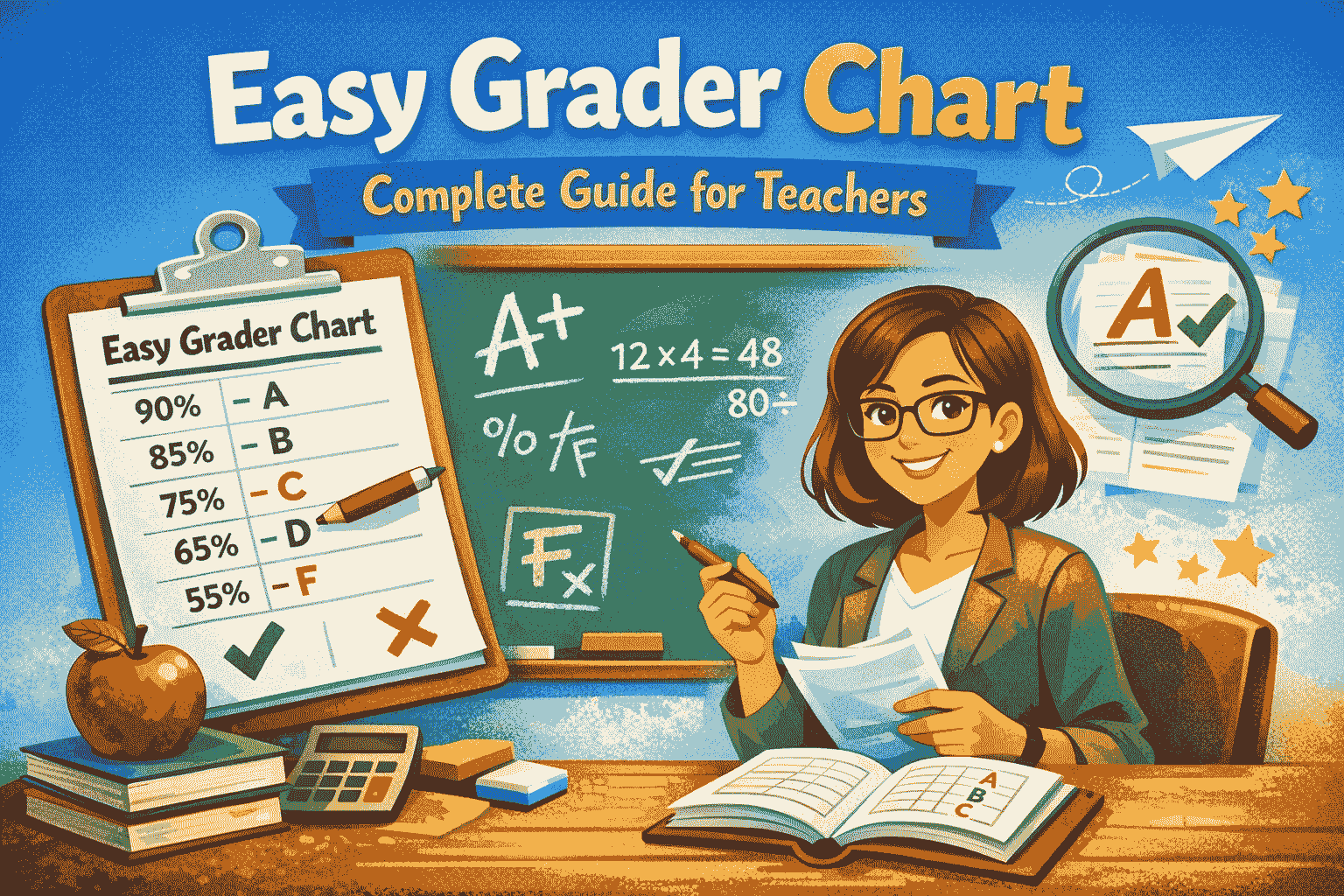
If you’re searching for a simple, reliable way to convert raw test scores into percentages, an easy grader chart is one of the most effective tools available. Whether you’re a teacher handling large classrooms, a tutor grading practice tests, or a student trying to understand scoring systems, this guide will give you everything you need to know.
This in-depth, SEO-optimized article covers how an easy grader chart works, how to use it, examples across different test sizes, practical applications, advanced tips, and frequently asked questions.
What Is an Easy Grader Chart?
An easy grader chart is a pre-calculated table that converts the number of correct answers into a percentage score. Instead of performing manual calculations or using an EZ Grader tool for each paper, you simply look up the number of correct answers and instantly find the corresponding percentage.
Simple Example:
- Total questions: 20
- Correct answers: 16
- Easy grader chart result: 80%
This eliminates the need for formulas or calculators and ensures consistency in grading.
Why the Easy Grader Chart Is Essential for Teachers
In modern classrooms—especially those with large student populations—grading efficiency matters. Here’s why the easy grader chart has become a staple tool:
1. Saves Significant Time
Grading manually for each student can take hours. An easy grader chart reduces grading time dramatically by eliminating repetitive calculations.
2. Minimizes Human Error
Even small math mistakes can affect grades. Charts provide pre-calculated values, ensuring accuracy.
3. Standardizes Grading
Every student is graded using the same conversion method, ensuring fairness.
4. No Technology Required
Unlike grading software, a printed easy grader chart works anywhere—no devices or internet needed.
5. Beginner-Friendly
New teachers or teaching assistants can use it immediately without training.
The Formula Behind an Easy Grader Chart
At its core, every easy grader chart is based on a simple percentage formula:Percentage=(Total QuestionsCorrect Answers)×100
Example:
- Correct answers: 18
- Total questions: 20
- Calculation: (18 ÷ 20) × 100 = 90%
The chart simply precomputes these values so you don’t have to.
Easy Grader Chart Example (Out of 10 Questions)
| Correct Answers | Percentage |
|---|---|
| 10 | 100% |
| 9 | 90% |
| 8 | 80% |
| 7 | 70% |
| 6 | 60% |
| 5 | 50% |
| 4 | 40% |
| 3 | 30% |
| 2 | 20% |
| 1 | 10% |
| 0 | 0% |
Easy Grader Chart Example (Out of 25 Questions)
| Correct Answers | Percentage |
|---|---|
| 25 | 100% |
| 24 | 96% |
| 23 | 92% |
| 22 | 88% |
| 21 | 84% |
| 20 | 80% |
| 19 | 76% |
| 18 | 72% |
| 17 | 68% |
| 16 | 64% |
| 15 | 60% |
These tables demonstrate how easy grader charts scale across different test sizes.
How to Use an Easy Grader Chart (Step-by-Step)
Using an easy grader chart is straightforward and requires no technical knowledge.
Step 1: Count Correct Answers
Go through the student’s test and tally the number of correct responses.
Step 2: Identify Total Questions
Make sure you’re using the correct chart for the test (e.g., 20 questions vs 50 questions).
Step 3: Locate the Score
Find the row corresponding to the number of correct answers.
Step 4: Record the Percentage
Write down the percentage or convert it into a letter grade if required.
Converting Percentages to Letter Grades
Many schools use letter grading systems. Here’s a common conversion scale:
| Percentage | Grade |
|---|---|
| 90–100% | A |
| 80–89% | B |
| 70–79% | C |
| 60–69% | D |
| Below 60% | F |
Using an easy grader chart makes it easy to apply these ranges consistently.
Easy Grader Chart vs Other Grading Methods
Easy Grader Chart
- Fastest method
- No calculations required
- Ideal for repetitive grading
Manual Calculation
- Time-consuming
- Prone to errors
EZ Grader Calculator or Spreadsheet
- EZ Grader calculators are accurate but slower than charts
- Requires devices
Conclusion: The easy grader chart offers the best balance of speed, simplicity, and accuracy.
Practical Applications of an Easy Grader Chart
1. Classroom Quizzes
Quickly grade daily or weekly quizzes without wasting class time.
2. Standardized Test Practice
Useful for SAT, ACT, or other exam preparation.
3. Homework Assignments
Efficient for checking large volumes of student work.
4. Online Learning Platforms
Can be integrated into grading workflows.
5. Tutoring Sessions
Helps tutors provide instant feedback to students.
Printable vs Digital Easy Grader Charts
Printable Charts
- Easy to use in classrooms
- No need for devices
- Can be laminated for reuse
Digital Charts
- Interactive and customizable
- Ideal for remote teaching
- Can be embedded in grading tools
How to Create Your Own Easy Grader Chart
Creating a custom easy grader chart is simple using spreadsheet tools.
Using Excel or Google Sheets:
- Enter total number of questions
- List correct answers from 0 to total
- Use this formula: = (Correct Answers / Total Questions) * 100
- Format the results as percentages
You now have a fully functional easy grader chart tailored to your needs.
Advanced Tips for Using an Easy Grader Chart
1. Use Multiple Charts
Keep charts for 10, 20, 25, 50, and 100 questions.
2. Color-Code Scores
Highlight grade ranges (A, B, C) for faster grading.
3. Laminate for Durability
Printed charts last longer and can be reused daily.
4. Combine with Rubrics
Use charts for objective questions and rubrics for subjective grading.
5. Double-Check Edge Cases
Ensure accuracy for borderline scores (e.g., 59% vs 60%).
Benefits for Students
An easy grader chart doesn’t just help teachers—it also benefits students:
- Transparency: Students understand how grades are calculated
- Faster Feedback: Immediate results improve learning
- Motivation: Clear scoring encourages improvement
Common Mistakes to Avoid
Even though easy grader charts are simple, mistakes can still happen:
- Using the wrong chart for the test size
- Misreading rows or columns
- Not rounding percentages consistently
- Ignoring partial credit situations
Limitations of an Easy Grader Chart
While highly effective, easy grader charts do have limitations:
- Not suitable for weighted grading systems
- Cannot handle partial credit easily
- Limited flexibility for complex scoring methods
For these cases, spreadsheets or grading software may be more appropriate.
Easy Grader Chart vs Test Score Calculator (Key Differences)
1. Definition
Easy Grader Chart
An easy grader chart is a pre-made lookup table that shows the percentage score for a given number of correct answers out of a fixed total (e.g., 10, 20, 50 questions).
You simply look up the score.
Test Score Calculator
A test score calculator is a dynamic tool or formula-based system that calculates the percentage automatically when you input values.
It uses math:Score=(Total QuestionsCorrect Answers)×100
Frequently Asked Questions (FAQ)
What is an easy grader chart?
An easy grader chart is a table that converts the number of correct answers into a percentage score, allowing quick and accurate grading.
How accurate is an easy grader chart?
It is highly accurate because it uses pre-calculated values based on standard mathematical formulas.
Can I use an easy grader chart for any test?
Yes, as long as the chart matches the total number of questions on the test.
Is an easy grader chart better than a calculator?
For speed and convenience, yes. For complex grading, a calculator may still be needed.
Are easy grader charts free?
Most charts are available for free online or can be created easily.
Can I customize an easy grader chart?
Yes, you can create custom charts using Excel or Google Sheets.
Do easy grader charts work for online teaching?
Absolutely. Digital versions can be integrated into online workflows.
Conclusion: Why Every Teacher Needs an Easy Grader Chart
The easy grader chart remains one of the most practical tools in education. It simplifies grading, improves accuracy, and saves valuable time—especially in large classrooms or fast-paced teaching environments.
Whether you prefer a printed version or a digital solution, incorporating an easy grader chart into your workflow can significantly enhance efficiency and consistency. For teachers looking to streamline grading without sacrificing accuracy, this tool is indispensable.