
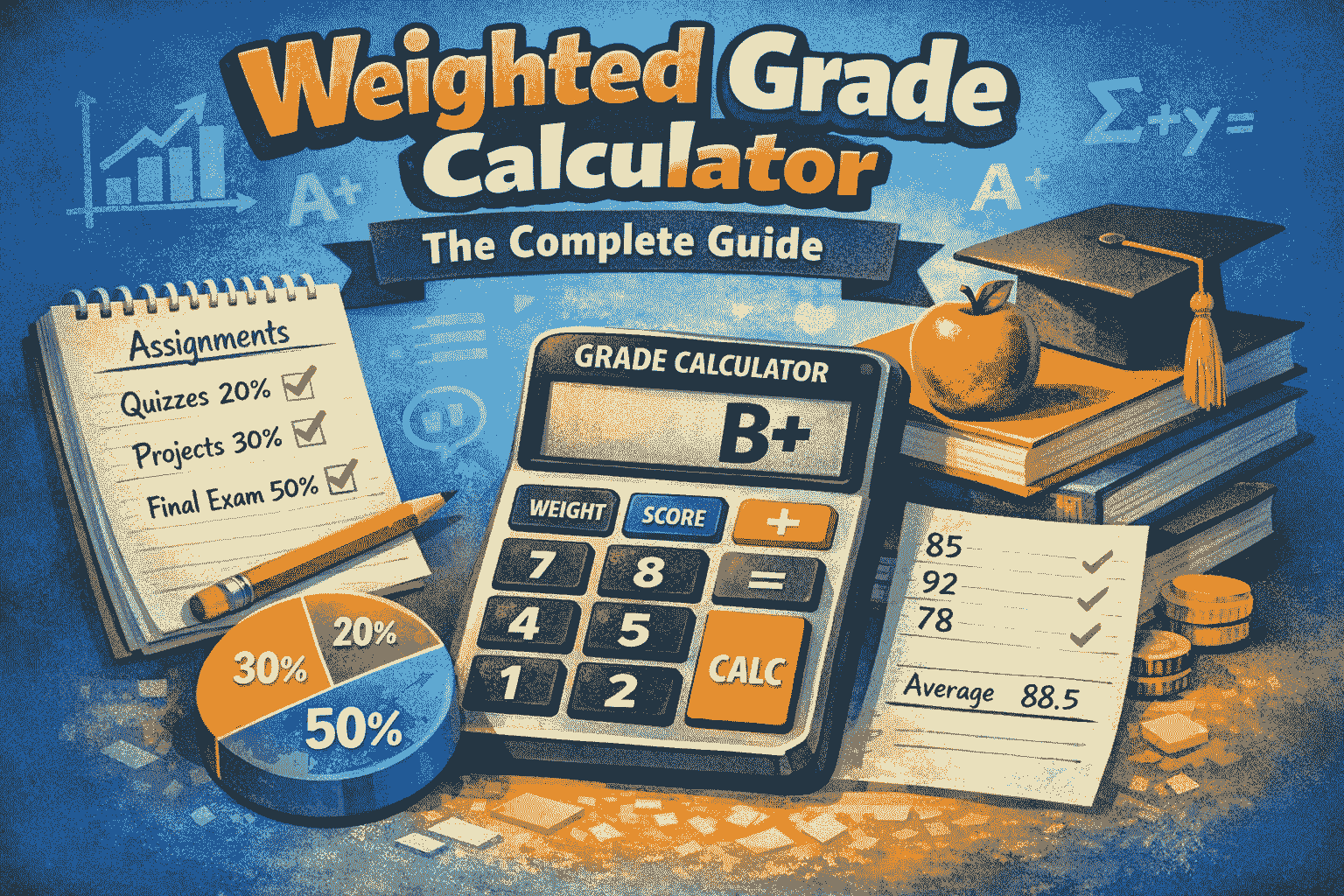
Understanding how grades are calculated is a crucial part of modern education, especially in systems where different assignments carry different levels of importance. One of the most widely used and academically reliable methods is the weighted grade calculator, which ensures that final grades reflect both the difficulty and significance of each assessment type.
In today’s education system, simple averaging is no longer sufficient. Students are evaluated across multiple categories such as exams, quizzes, assignments, participation, and projects. Each of these contributes differently to overall performance. This is exactly where the weighted grade calculator becomes essential.
This comprehensive guide explains everything about the weighted grade calculator, including detailed formulas, real-world examples, step-by-step instructions, advanced calculations, classroom applications, digital tools, and common mistakes to avoid.
What Is a Weighted Grade Calculator?
A weighted grade calculator is a structured mathematical method or digital tool used to compute a student’s final grade by assigning different importance levels (weights) to different academic categories. Instead of treating all scores equally, it acknowledges that some assessments are more important than others in measuring overall learning outcomes.
In simple terms, a weighted grade calculator is a system that multiplies each category score by its assigned weight and then adds all the results together to produce a final percentage or grade.
Expanded Explanation:
Unlike traditional grading systems where all assignments contribute equally, weighted grading reflects the reality of academic evaluation. For example, a final exam typically demonstrates a deeper understanding of the subject than a weekly homework assignment. Therefore, it carries more weight in the final grade calculation.
A weighted grade calculator ensures that:
- High-impact assessments influence grades more significantly
- Smaller assignments contribute proportionally
- The final grade reflects overall academic performance accurately
- Teachers maintain consistent and fair evaluation standards across students
👉 Essentially, it creates a more realistic representation of student achievement.
Why Weighted Grade Calculators Are Important in Education
Weighted grading systems are widely used across schools, universities, and professional training programs because they offer a more accurate reflection of student learning.
1. Ensures Fair Academic Evaluation
One of the most important advantages of a weighted grade calculator is fairness. Not all assignments measure the same level of understanding, and treating them equally would distort student performance.
Expanded Explanation:
For example:
- A 10-point homework assignment should not affect the final grade as much as a 100-point final exam
- A class participation score reflects engagement, not mastery
- A project may demonstrate deeper understanding than a quiz
A weighted system ensures that each component contributes appropriately based on its educational importance, creating a more balanced evaluation system.
2. Encourages Better Student Learning Behavior
Weighted grading directly influences how students prioritize their academic effort.
Expanded Explanation:
When students understand that:
- Exams carry higher weight
- Projects require more effort
- Homework supports but does not dominate grades
They naturally begin to allocate their time more strategically. This leads to:
- Better preparation for major assessments
- Improved study habits
- Reduced last-minute cramming
- More balanced academic performance
👉 In essence, weighted grading encourages students to focus on meaningful learning rather than point accumulation.
3. Reflects Real Academic Priorities
Educational institutions design curricula with intentional learning priorities. A weighted grade calculator ensures these priorities are reflected in final evaluations.
Expanded Explanation:
For example:
- Exams test deep comprehension and critical thinking
- Assignments reinforce daily learning
- Participation measures engagement and communication
- Projects demonstrate applied knowledge
By assigning weights to these categories, educators ensure that final grades reflect the actual learning structure of the course rather than just raw scores.
4. Reduces the Impact of Isolated Poor Performance
Without weighted grading, a single poor score can disproportionately affect a student’s overall grade.
Expanded Explanation:
A weighted system protects students from:
- One-time mistakes
- Illness during a test
- Unexpected performance drops
- Minor assignment errors
Because smaller components have lower weight, they do not significantly distort the final outcome. This creates a more stable and fair grading system.
5. Widely Used in Higher Education Systems
Most universities and professional certification programs rely heavily on weighted grading systems.
Expanded Explanation:
This is because:
- Courses often include multiple evaluation categories
- Academic rigor requires differentiated assessment methods
- Final exams typically carry significant weight
- Research projects and labs are evaluated separately
👉 Weighted grading is considered the global standard for higher education evaluation systems.
How a Weighted Grade Calculator Works
A weighted grade calculator operates using a simple but powerful mathematical principle: each score is multiplied by its assigned weight, and all weighted values are added together to form the final grade.
Core Formula (Expanded Understanding)
Final Grade=∑(Score×Weight)
Expanded Explanation:
This formula ensures that:
- Each category contributes proportionally
- Higher weight categories influence the final grade more
- The final result always sums to a realistic academic score
- Calculation remains consistent across different subjects and institutions
👉 It is essentially a structured method of averaging with importance factors.
Step-by-Step Example of Weighted Grade Calculator
Let’s break down a realistic academic scenario in detail.
Student Performance:
- Exams: 85% (Weight = 50%)
- Homework: 90% (Weight = 30%)
- Participation: 100% (Weight = 20%)
Step 1: Multiply Each Score by Its Weight
Expanded Explanation:
- Exams: 85 × 0.50 = 42.5
- Homework: 90 × 0.30 = 27
- Participation: 100 × 0.20 = 20
Each category is scaled according to its importance before combining results.
Step 2: Add Weighted Values Together
42.5+27+20=89.5%
Final Result:
The student’s final grade is 89.5%, which typically falls into the A- or B+ range depending on institutional grading policies.
Weighted Grade Calculator Table
| Category | Score | Weight | Weighted Contribution | Explanation |
|---|---|---|---|---|
| Exams | 85% | 50% | 42.5 | Major assessment reflecting core knowledge |
| Homework | 90% | 30% | 27 | Reinforcement of learning concepts |
| Participation | 100% | 20% | 20 | Measures engagement and class involvement |
| Total | — | 100% | 89.5% | Final computed academic performance |
👉 This table shows how different academic components contribute to the final grade in a structured and transparent way.
How to Use a Weighted Grade Calculator
Step 1: Identify All Grade Categories
In most academic systems, categories include:
- Exams
- Quizzes
- Homework
- Projects
- Class participation
Expanded Explanation:
Each category represents a different aspect of student learning. Identifying them correctly ensures that the grading system reflects the structure of the course.
Step 2: Assign Proper Weights
Each category must be assigned a percentage value.
Expanded Explanation:
Example distribution:
- Exams = 40%
- Quizzes = 20%
- Homework = 20%
- Final project = 20%
👉 The total must always equal 100% to maintain calculation accuracy.
Step 3: Convert Scores Into Percentages
All raw scores must be standardized into percentage form before calculation.
Step 4: Multiply Scores by Weights
Each category score is multiplied by its assigned weight.
Step 5: Sum All Weighted Values
The final grade is the total of all weighted contributions.
Weighted Grade Calculator vs Simple Average
| Feature | Weighted Grade Calculator | Simple Average |
|---|---|---|
| Accuracy | High | Medium |
| Fairness | High | Low |
| Complexity | Moderate | Low |
| Real-world usage | Standard | Limited |
👉 Weighted systems are significantly more accurate and widely used in academic institutions.
Real-Life Applications of Weighted Grade Calculators
Schools and Universities
Used for:
- Semester grading
- Final course evaluation
- Academic transcripts
Online Learning Platforms
Platforms like Coursera and Udemy use weighted grading for:
- Assignments
- Quizzes
- Final exams
Certification Programs
Professional certifications assign different weights to:
- Theory exams
- Practical tests
- Project work
Corporate Training
Used to evaluate employee performance across multiple training modules.
Common Mistakes in Weighted Grade Calculation
1. Incorrect Weight Distribution
If weights do not add up to 100%, the final grade becomes invalid.
2. Mixing Raw Scores and Percentages
All inputs must be standardized before calculation.
3. Ignoring Category Importance
Misaligned weights distort academic evaluation.
4. Rounding Too Early
Premature rounding leads to inaccurate final results.
Advantages of Weighted Grade Calculator
1. Highly Accurate Academic Evaluation
Reflects real student performance across different assessment types.
2. Flexible Academic Design
Can be adapted to any course structure or subject.
3. Fair Distribution of Scores
Prevents minor assignments from overly influencing final grades.
4. Easy to Automate
Works efficiently with Excel, Google Sheets, and LMS systems.
FAQ: Weighted Grade Calculator
What is a weighted grade calculator?
A weighted grade calculator is a system that calculates final grades by assigning different importance levels to various academic categories and combining them using weighted averages.
How do you calculate weighted grades?
Multiply each category score by its weight and add all results together.
Why are weighted grades used?
They ensure fair and accurate evaluation by reflecting the importance of each academic component.
Can I calculate weighted grades in Excel?
Yes, Excel and Google Sheets are commonly used for automated weighted grade calculations.
What happens if weights don’t equal 100%?
The final grade will be incorrect and not properly scaled.
Is weighted grading better than average grading?
Yes, because it reflects academic importance more accurately.
Conclusion
The weighted grade calculator is one of the most accurate and widely used systems in education today. It ensures fairness, consistency, and academic integrity by properly reflecting the importance of different assessment types.
Whether used in schools, universities, or online platforms, weighted grading provides a realistic and structured way to evaluate student performance.
By understanding how it works, educators and students can better interpret academic results and improve learning outcomes.